The City of Berkeley Building Emissions Saving Ordinance (BESO), is a citywide energy benchmarking & disclosure program requiring owners of existing buildings to report energy, water, and building use annually, using ENERGY STAR® Portfolio Manager®. Effective as of January 2015, this program provides building owners insight into their building’s energy efficiency and helps meet the City of Berkeley’s Climate Action Plan goals.

BEGIN COMPLIANCE NOW

WHAT BUILDINGS ARE COVERED UNDER BERKELEY BESO?

Property Type & Requirement
  • Buildings between 850-14,999 Sq. Ft. and 1-4 unit homes require an energy assessment when listed for sale.
  • Buildings between 15,000 and 24,999 Sq. Ft. require annual benchmarking and must conduct an energy assessment when listed for sale.
  • Buildings 25,000 Sq. Ft. or more require annual benchmarking and an energy assessment every 5 years.

WHAT INFORMATION IS REQUIRED FOR BENCHMARKING?

Annual benchmarking reporting requires 12 calendar months of whole-building energy and building use data. For example, in 2025, building owners must report 12 months of 2024 data.

WHEN ARE BERKELEY BESO BENCHMARKING REPORTS DUE?

July 1, annually. Benchmarking reports must be submitted on an annual basis using the previous year’s data via ENERGY STAR® Portfolio Manager®. This is the EPA’s benchmarking tool that is used for compliance reporting in most ordinances across the country.

WHAT INFORMATION IS REQUIRED FOR BPS?

Building Performance Standards (BPS) are often considered Phase II of these building energy use ordinances. After reporting your benchmarking data, many ordinances require you to make changes to the building’s operations or equipment to lower energy use over time.

Under Berkeley BESO buildings 850-24,999 Sq. Ft. must hire a qualified assessor to complete an energy assessment and report before listing the building for sale, and provide it to the City and prospective buyers. Alternatively, sellers may defer the BESO assessment requirement to the buyer. 

For buildings 25,000 Sq. Ft. and larger, owners must submit energy assessments every five years and energy benchmarks annually to comply with the Building Emissions Saving Ordinance (BESO). Some buildings qualify for exemptions or deferrals; refer to the summary document for details. Collect verification documentation, such as your ENERGY STAR report or building permit, to submit with your application. 

WHEN ARE BERKELEY BESO ASSESSMENTS DUE?

Energy assessments are due every 5 years for buildings over 25,000 Sq. Ft. The first was due July 1, 2019. So, future assessment years will be 2029, 2034, 2039, etc.

Remember, smaller buildings do not need to complete assessments on this cycle. They only need to do so when listing the property for sale.

WHAT ARE THE PENALTIES IF YOU DON'T COMPLY WITH BERKELEY BESO?

Failure to comply with Berkeley BESO can result in an $85 administrative late fee. After 90-day notice, citation penalties range from $100 – $500 per violation, per day.

HOW DO I COMPLY WITH BERKELEY BESO?

CONTACT US HERE to learn more and get started with compliance.

Berkeley BESO compliance can be confusing and hard to navigate. Bringing on a consultant like VCA Green streamlines the entire process while ensuring accurate reporting. We also offer free consultations with our benchmarking clients to review the reports and identify inefficiencies to improve.

WHEN SHOULD I START BERKELEY BESO COMPLIANCE?

Ordinances such as Berkeley BESO are already in effect across the country, and deadlines are rapidly approaching. Retrieving historical building data will take time, especially when coordinating with property managers and utilities.

Waiting until the last minute risks missing compliance windows resulting in fines and enforcement penalties. VCA Green takes every measure to ensure complete and accurate data collection. The sooner you reach out, the sooner you will reach compliance.

BERKELEY BESO RESOURCES

Policy

Berkeley BESO

Bill Text

Berkeley Climate Action Plan

Enforcing Agency

City of Berkeley

VCA GREEN IS A BERKELEY BESO AUTHORIZED SERVICE PROVIDER

VCA GREEN PROCESS

With every phase of the process, VCA Green’s experienced and knowledgeable team is here to guide you on the results, options, and path forward to meet your compliance goals.

RELEVANT SERVICES


The City of New Orleans Building Energy Benchmarking Ordinance is a citywide energy benchmarking & disclosure program requiring owners of existing buildings to report energy use annually, using ENERGY STAR® Portfolio Manager®. Effective as of June 2025, this program provides building owners insight into their building’s energy efficiency and helps meet the City of New Orleans’ Climate Action Plan goals.

BEGIN COMPLIANCE NOW

WHAT BUILDINGS ARE COVERED UNDER NEW ORLEANS BENCHMARKING?

Property Size

Non-residential and multifamily buildings over 20,000 Sq. Ft.

WHAT INFORMATION IS REQUIRED FOR BENCHMARKING?

Annual benchmarking reporting requires 12 calendar months of whole-building energy and building use data. For example, in 2025, building owners must report 12 months of 2024 data.

WHEN ARE NEW ORLEANS BENCHMARKING REPORTS DUE?

May 31, annually*. Benchmarking reports must be submitted on an annual basis using the previous year’s data via ENERGY STAR® Portfolio Manager®. This is the EPA’s benchmarking tool that is used for compliance reporting in most ordinances across the country.

*Buildings over 50,000 Sq. Ft. need to comply beginning January 1, 2026. Buildings between 20,000 and 50,000 Sq. Ft. begin reporting January 1, 2027.

WHAT INFORMATION IS REQUIRED FOR BPS?

Building Performance Standards (BPS) are often considered Phase II of these building energy use ordinances. After reporting your benchmarking data, many ordinances require you to make changes to the building’s operations or equipment to lower energy use over time.

New Orleans does not require BPS compliance at this time. However, improving your building’s efficiency can lower your operating costs, improve your NOI, and save you money in the long run.

WHAT IS THIRD-PARTY DATA VERIFICATION?

Third-party data verification requires owners/managers of covered buildings to hire a third-party expert who will independently review and verify the building’s benchmarking data.

New Orleans does not require data verification at this time.

WHAT ARE THE PENALTIES IF YOU DON'T COMPLY WITH NEW ORLEANS BENCHMARKING?

Violating any aspect of the New Orleans Building Energy Benchmarking Ordinance will result in fines between $1,000 and $3000. 

Penalties are waived for buildings in their first year of compliance.

HOW DO I COMPLY WITH NEW ORLEANS BENCHMARKING?

CONTACT US HERE to learn more and get started with compliance.

New Orleans Building Energy Benchmarking Ordinance compliance can be confusing and hard to navigate. Bringing on a consultant like VCA Green streamlines the entire process while ensuring accurate reporting. We also offer free consultations with our benchmarking clients to review the reports and identify inefficiencies to improve.

WHEN SHOULD I START NEW ORLEANS BENCHMARKING COMPLIANCE?

Ordinances such as the New Orleans Building Energy Benchmarking Ordinance are already in effect across the country, and deadlines are rapidly approaching. Retrieving historical building data will take time, especially when coordinating with property managers and utilities.

Waiting until the last minute risks missing compliance windows resulting in fines and enforcement penalties. VCA Green takes every measure to ensure complete and accurate data collection. The sooner you reach out, the sooner you will reach compliance.

VCA GREEN PROCESS

With every phase of the process, VCA Green’s experienced and knowledgeable team is here to guide you on the results, options, and path forward to meet your compliance goals.

RELEVANT SERVICES

The City of Cambridge Building Energy Use Disclosure Ordinance (Cambridge BEUDO), is a citywide energy benchmarking & disclosure program requiring owners of existing buildings to report energy and water use annually, using ENERGY STAR® Portfolio Manager®. Effective as of June 2023, this program provides building owners insight into their building’s energy efficiency and helps meet the City of Cambridge’s Climate Action Plan goals.

BEGIN COMPLIANCE NOW

WHAT BUILDINGS ARE COVERED UNDER CAMBRIDGE BEUDO?

Property Size

Commercial buildings over 25,000 Sq .Ft. or 50+ residential dwelling units.

Municipal buildings over 10,000 Sq. Ft.

WHAT INFORMATION IS REQUIRED FOR BENCHMARKING?

Annual benchmarking reporting requires 12 calendar months of whole-building energy, water, and building use data. For example, in 2025, building owners must report 12 months of 2024 data.

WHEN ARE CAMBRIDGE BEUDO BENCHMARKING REPORTS DUE?

May 1, annually. Benchmarking reports must be submitted on an annual basis using the previous year’s data via ENERGY STAR® Portfolio Manager®. This is the EPA’s benchmarking tool that is used for compliance reporting in most ordinances across the country.

WHAT INFORMATION IS REQUIRED FOR BPS?

Building Performance Standards (BPS) are often considered Phase II of these building energy use ordinances. After reporting your benchmarking data, many ordinances require you to make changes to the building’s operations or equipment to lower energy use over time.

Cambridge BEUDO requires covered properties to meet Greenhouse Gas (GHG) Emissions reductions requirements on a schedule outlined below. These reductions use the baseline years 2018-2019, meaning they must meet the reduction targets relative to the data from those years.

WHEN ARE CAMBRIDGE BEUDO BPS REPORTS DUE?

For Buildings Over 100,000 Sq. Ft.

Compliance Period 1 (2026-2029) – annual GHG emissions must be reduced by at least 20% from baseline.

Compliance Period 2 (2030-2034) – annual GHG emissions must be reduced by at least 60% from baseline.

From 2035 onwards, GHG emissions will not exceed zero.

For Buildings Between 25,000 Sq. Ft. and 100,000 Sq. Ft.

Compliance Period 1 (2026-2029) – annual GHG emissions cannot be more than emissions from the baseline year.

Compliance Period 2 (2030-2034) – annual GHG emissions must be reduced by at least 40% from baseline.

Compliance Period 3 (2035-2039) – annual GHG emissions must be reduced by at least 60% from baseline.

Compliance Period 4 (2040-2044) – annual GHG emissions must be reduced by at least 80% from baseline.

Compliance Period 5 (2045-2049) – annual GHG emissions must be reduced by at least 90% from baseline.

From 2050 onwards, annual GHG emissions will not exceed zero.

WHAT IS THIRD-PARTY DATA VERIFICATION?

Third-party data verification requires owners/managers of covered buildings to hire a third-party expert who will independently review and verify the building’s benchmarking data.

Under Cambridge BEUDO, data verification was required for the two baseline years (2018-2019) and is required during the first year of each BPS compliance period.

WHAT ARE THE PENALTIES IF YOU DON'T COMPLY WITH CAMBRIDGE BEUDO?

BEUDO violations will result in:

  • A written warning for first violation

  • Fines of $300 per violation, per day for any subsequent violations

    • Each day that a property remains in violation will be considered a separate offense

These penalty guidelines apply individually to all aspects of the ordinance including, benchmarking, data verification, and emissions reduction requirements.

HOW DO I COMPLY WITH CAMBRIDGE BEUDO?

CONTACT US HERE to learn more and get started with compliance.

Cambridge BEUDO compliance can be confusing and hard to navigate. Bringing on a consultant like VCA Green streamlines the entire process while ensuring accurate reporting. We also offer free consultations with our benchmarking clients to review the reports and identify inefficiencies to improve.

WHEN SHOULD I START CAMBRIDGE BEUDO COMPLIANCE?

Ordinances such as Cambridge BEUDO are already in effect across the country, and deadlines are rapidly approaching. Retrieving historical building data will take time, especially when coordinating with property managers and utilities.

Waiting until the last minute risks missing compliance windows resulting in fines and enforcement penalties. VCA Green takes every measure to ensure complete and accurate data collection. The sooner you reach out, the sooner you can achieve compliance.

VCA GREEN APPROACH

With every phase of the process, VCA Green’s experienced and knowledgeable team is here to guide you on the results, options, and path forward to meet your compliance goals.

RELEVANT SERVICES

The City of Clayton Building Energy Awareness Ordinance is a citywide energy benchmarking & disclosure program requiring owners of existing buildings to report energy and water use annually, using ENERGY STAR® Portfolio Manager®. Effective as of February 2025, this program provides building owners insight into their building’s energy efficiency and helps meet the City of Clayton’s Climate Action Plan goals.

BEGIN COMPLIANCE NOW

WHAT BUILDINGS ARE COVERED UNDER CLAYTON BUILDING ENERGY AWARENESS ORDINANCE?

Group 1 Properties

Buildings owned or partially owned by the City of Clayton over 10,000 Sq. Ft.

Group 2 Properties

Non-City buildings over 100,000 Sq. Ft.

WHAT INFORMATION IS REQUIRED FOR BENCHMARKING?

Annual benchmarking reporting requires 12 calendar months of whole-building energy, water, and building use data. For example, in 2025, building owners must report 12 months of 2024 data.

WHEN ARE CLAYTON BENCHMARKING REPORTS DUE?

April 1, annually. Group 1 Properties begin reporting in 2025. Group 2 Properties begin reporting in 2027.

Benchmarking reports must be submitted on an annual basis using the previous year’s data via ENERGY STAR® Portfolio Manager®. This is the EPA’s benchmarking tool that is used for compliance reporting in most ordinances across the country.

WHAT INFORMATION IS REQUIRED FOR BPS?

Building Performance Standards (BPS) are often considered Phase II of these building energy use ordinances. After reporting your benchmarking data, many ordinances require you to make changes to the building’s operations or equipment to lower energy use over time.

The Clayton Building Energy Awareness Ordinance does not require building efficiency improvement at this time.

WHAT IS THIRD-PARTY DATA VERIFICATION?

Third-party data verification requires owners/managers of covered buildings to hire a third-party expert who will independently review and verify the building’s benchmarking data.

The Clayton Building Energy Awareness Ordinance does not require data verification at this time.

WHAT ARE THE PENALTIES IF YOU DON'T COMPLY WITH THE CLAYTON BUILDING ENERGY AWARENESS ORDINANCE?

Failure to comply with the Clayton Building Energy Awareness Ordinance will result in a fine up to $1,000 to the building owner. Each day a violation continues constitutes a separate offense.

HOW DO I COMPLY WITH CLAYTON BUILDING ENERGY AWARENESS ORDINANCE?

CONTACT US HERE to learn more and get started with compliance.

Clayton Building Energy Awareness compliance can be confusing and hard to navigate. Bringing on a consultant like VCA Green streamlines the entire process while ensuring accurate reporting. We also offer free consultations with our benchmarking clients to review the reports and identify inefficiencies to improve.

WHEN SHOULD I START CLAYTON BUILDING ENERGY AWARENESS ORDINANCE COMPLIANCE?

Ordinances such as Clayton Building Energy Awareness Ordinance are already in effect across the country, and deadlines are rapidly approaching. Retrieving historical building data will take time, especially when coordinating with property managers and utilities.

Waiting until the last minute risks missing compliance windows resulting in fines and enforcement penalties. VCA Green takes every measure to ensure complete and accurate data collection. The sooner you reach out, the sooner you will reach compliance.

CLAYTON BUILDING ENERGY AWARENESS ORDINANCE RESOURCES

VCA GREEN PROCESS

With every phase of the process, VCA Green’s experienced and knowledgeable team is here to guide you on the results, options, and path forward to meet your compliance goals.

RELEVANT SERVICES

After January 1, 2025, California will have effectively banned the sale and distribution of all fluorescent lamps per CA AB 2208. So, what does this mean for business owners and property managers? Those currently using these lamps must start planning to transition to alternative lighting solutions. Although this may require some planning and investment, upgrading to LED lighting is safer and more efficient, contributing to huge operational savings.

Why is CA Banning Fluorescents?

One of the biggest concerns with fluorescent lighting is safety; these lamps contain mercury, a toxic heavy metal that poses significant environmental and health risks. When disposed of in landfills, the mercury contaminates ecosystems through leaching into the soil and water. In addition to these environmental and public health threats, fluorescents are also incredibly inefficient compared to LEDs. They produce more heat bringing operational costs up across all systems and have a shorter life cycle.

Upgrading to LED lighting will save business owners money while protecting Californians’ health and safety.

Here is Your Lighting Retrofit Action Plan

  • Ban Date
    • January 1, 2025 (screw and bayonet base CFLs banned starting 1/1/24)
  • Next Steps for Business Owners
    • Assess Inventory: How many lamps do you have in stock? This will help you plan and prioritize when to implement an LED lighting retrofit.
    • Budget for Retrofit: While equipment may be compatible, it is best to scope out the project needs to ensure safety and compatibility. Long-term cost savings of proper LED lighting retrofits are higher than the short-term gain of simply replacing bulbs. Not to mention, safer for the occupant.
    • Properly Dispose of Fluorescents: Become familiar with your local regulations, procedures, and disposal facilities to ensure lamps can be removed, recycled, and disposed of properly. The EPA  provides helpful information and resources for commercial use.
  • Retrofit Priorities
    • Decide project goals and budget.
    • Assess and identify lamp counts, high-burn areas (parking garages, stairwells, etc.), and other inefficiencies to address.
    • Explore your options and determine the best equipment and products for each area.
    • Take advantage of utility incentives and rebates, while they are available.
    • Measure and verify your energy and cost savings through bill analysis and/or benchmarking the building.

Green Econome Specializes in LED Lighting Retrofits… We Can Help You Transition!

Hiring a professional service provider often leads to the best results. Leverage their knowledge and access to contractors/distributors. Get ahead of the ban and take advantage of current incentives for energy efficiency upgrades. Business owners will save money and help keep their community safe by switching to LED lighting! In addition to upgrading the building’s lighting, Green Econome delivers a pre/post-install analysis to track savings. While we have implemented a variety of LED retrofits including, office, residential, and sport lighting, One of our biggest retrofit projects was conducted for a global aerospace company and ultimately resulted in a 25% cost reduction. This retrofit included lighting, HVAC, and thermostat systems. Green Econome is here to help you start saving now!

RELEVANT SERVICES

Here at Green Econome, we’ve been at the forefront of ESG (Environmental, Social, Governance) reporting, eagerly anticipating the U.S. Securities and Exchange Commission (SEC) ruling on mandatory disclosures for public companies. Fundamentally, ESG is a way of doing business. Green Econome lives in the world of the “E”, the “Environmental” with our ENERGY STAR® benchmarking and energy and water efficiency services. While we recognize that the “S” and the “G” are equally important for businesses to report on, we are going to focus on the “E” and how that relates to the SEC’s new ruling. Let’s get into it.

Unpacking the SEC Climate-Related Disclosures

What are public companies required to report and how does that intersect with commercial real estate? On March 6, 2024, the SEC passed legislation requiring public companies to measure their Scope 1 and 2 emissions as part of their annual reporting and include how climate risk will affect their businesses in the near future. This ruling is meant to enhance and standardize climate-related disclosures. The SEC also included a materiality clause to help guide businesses as to what to report. Although, it’s important to note that since March, there has been intense business opposition. But let’s get to the bottom line here: what are Scope 1 and Scope 2 emissions and why do we need to report on them?

Defining Scope 1, 2, and 3 Emissions

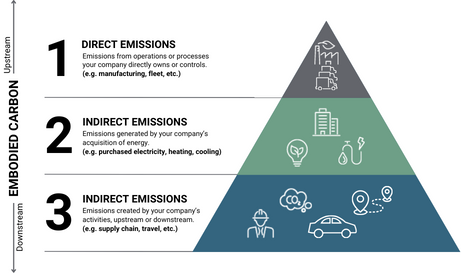
Scope Emissions Pyramid

Basically, Scope 1 is for all direct Greenhouse Gas (GHG) emissions through the combustion of gas in buildings or by the business’ fleet. Scope 2 is indirect emissions for the electricity the business is consuming from the grid. Both emissions are part of the collection of data standard to ENERGY STAR benchmarking. Scope 3, although significant, was not included in the SEC’s ruling.

The ‘E’ in ESG is where Green Econome thrives

We are here to ENERGY STAR Benchmark your portfolio to meet your “E” goals and reduce the operating costs of your building. As a woman-owned, full-service energy and water efficiency construction and consulting company, we have over 20 years of combined experience. We provide accurate benchmarking services and insights to recommend solutions and incentives that will increase the NOI and market value of your property. Let us help you better understand and accomplish your property’s ESG goals to reduce emissions and meet science-based targets (SBTi).

Contact Founder and CEO Marika Erdely
Mobile: 818-681-5750
Email: marikae@greeneconome.com

DOWNLOAD OUR ESG SERVICES BROCHURE

RELEVANT SERVICES

I love a good federal tax credit since it is a reduction of the tax liability of the owner. Essentially, this is pure cash flow to the owner of the property. What could be better? I have two favorites improved by the Inflation Reduction Act (IRA): the Federal Solar Investment Tax Credits (ITC) for Solar and Battery Storage, and a new 45L for residential construction and major renovations.

Federal Investment Tax Credits (ITC) for Solar and Battery Storage

While there is a suite of tax credits under the ITC for residential, businesses, and manufacturers, Let’s focus on the ITC for businesses. The investment tax credit (ITC) is a federal tax credit that reduces the federal income tax liability for a percentage of the cost of a solar or storage system that is installed during the tax year. Before the passage of the Inflation Reduction Act, this incentive was 26%, but with the help of the IRA, it is back up to 30% of the project cost until 2033. (U.S. Department of Energy).

There are two bonus tax credits at 10% a pop if they are attainable.

  • Energy Community Bonus: An energy community is an area identified as a brownfield site and/or locations experiencing high unemployment and fossil fuel investment. Looking at the DOE Energy Community map, most of Los Angeles County is currently designated as an energy community. Unfortunately, this is a temporary map and we in the industry aren’t exactly sure when the map is to be reset and areas may drop off.
  • Domestic Content Bonus: This bonus requires a percentage (starting at 40%) of project materials (by cost) to be produced in the U.S. It is difficult to attain the second additional 10% solar tax credit. I’m told businesses are hard at work on this, making domestic materials readily available. Hooray for U.S. manufacturing!

These projects also benefit from Federal MACRS Bonus Depreciation and State Depreciation (which is, again, a tax deduction—reducing the income of the property for tax purposes).

By the Numbers: Cash Flow for Solar and Battery Storage Projects

Let’s examine some examples of tax savings when installing a solar PV system or an energy storage system. Many people aren’t aware of just how much these tax incentives can help to cover the cost of the project. The numbers speak for themselves.

Energy Storage System (90kW/220kWh)

Gross System Cost  $ 318,244.00
IRA ITC (30% + 10% Energy Community)  $ (127,298.00) -40%
SCE SGIP Rebate Program to Owner  $ (55,750.00) -18%
Federal MACRS Bonus Depreciation  $ (53,465.00) -17%
State (CA) MACRS Depreciation  $ (31,824.00) -10%
Net Project Cost to Owner  $ 49,907.00 -84%
Estimated Electricity Savings (Year 1)  $ 20,939.00  
Estimated Total Net Savings (15 Years)  $ 260,574.00
Payback Period 3.1 Years

Solar PV System (29.4 kW-DC)

Gross System Cost  $ 110,344.00
IRA ITC (30% + 10% Energy Community)  $ (44,137.00) -40%
Federal MACRS Bonus Depreciation  $ (27,807.00) -25%
State (CA) MACRS Depreciation  $ (8,828.00) -8%
Net Project Cost to Owner  $ 29,572.00 -73%
Estimated Annual Electricity Savings (Year 1)  $ 9,700.00
Estimated Total Net Savings (25 Years)  $ 419,117.00
Payback Period  3.8 Years

Tax Benefits Can Cover Over 80% of the Project Cost

The tables above illustrate how HUGE these tax incentives are. In just over 3 years, the entire cost of the energy storage system will have paid itself back. The battery can offset peak kW demand costs in high Time-of-Use (TOU) rates. Looking at the numbers, these energy efficiency projects are a no-brainer.

Green Econome Project Consulting, Construction & Incentive Management Services Have You Covered

Green Econome is here to guide you through the decision-making process and provide you with maximum energy and tax savings! We are a woman-owned, full-service energy and water efficiency construction and consulting company with over 20 years of combined experience. If you have a building for which you are considering solar and battery storage and would like a no-obligation quote, please contact CEO, Marika Erdely.

RELEVANT SERVICES

What is the 45L Tax Credit?

The Inflation Reduction Act amended Section 45L, a tax credit to incentivize the new development or major renovation of energy-efficient residential properties for lease or sale. The new Section 45L provisions include two tiers of credits for eligible buildings and units certified to applicable ENERGY STAR® residential and U.S. Department of Energy Zero Energy Ready Home (ZERH) program requirements. The updated Section 45L is extended to qualified residential properties acquired from January 1, 2023, through December 31, 2032. The tax credit’s value per dwelling unit varies, reaching a maximum of $5,000, based on factors including the home type, number of stories, and compliance with energy efficiency requirements.

This residential construction tax credit is fantastic if you are already constructing or retrofitting at high efficiency and want to recognize your residential project as ENERGY STAR® or ZERH certified right off the bat.

Qualifying for the Section 45L Tax Credit

Here are the basic eligibility requirements for homes acquired and/or completed after December 31, 2022, and located in the U.S., wanting to claim Section 45L (as found on the Department of Energy and IRS websites). It is important to note that there are differences in terms for single-family vs. multi-family homes. Please contact Green Econome for detailed information. This is a basic outline:

Single Family Homes

  1. Certified under the applicable ENERGY STAR Single-Family New Homes (National} Program Requirements.
  2. Certified under the most recent ENERGY STAR Single-Family New Homes Program Requirements applicable to the location of such dwelling unit (as in effect on the latter of January 1, 2023, or January 1 of two calendar years prior to the date the dwelling unit was acquired), or
  3. Certified under the most recent ENERGY STAR Manufactured Home National program requirements as in effect on the latter of January 1, 2023, or January 1 of two calendar years prior to the date such dwelling unit is acquired.

Multi-Family Homes

  1. Certified under the most recent ENERGY STAR Multifamily New Construction National Program Requirements (as in effect on either January 1, 2023, or January 1 of three calendar years prior to the date the dwelling was acquired, whichever is later), and
  2. Certified under the most recent ENERGY STAR Multifamily New Construction Regional Program Requirements applicable to its location. (as in effect on either January 1, 2023, or January 1 of three calendar years prior to the date the dwelling was acquired, whichever is later).

All Eligible Dwelling Units

Must be certified as a zero-energy ready home under the Zero Energy Ready Home (ZERH) program of the Department of Energy as in effect on January 1, 2023 (or any successor program determined by the Secretary).

What are the Additional Benefits to the 45L Amended by the Inflation Reduction Act?

  • Increased credits: for homes acquired between 2023-2032.
  • Prevailing wage kicker: tax credit is higher for multifamily projects that meet the prevailing wage requirements.
  • Double the savings! 45L tax credit can also be utilized with the IRA’s Section 179D for buildings over 4 stories.

Green Econome Helps Maximize Savings on your Multifamily Projects

While Green Econome is not a tax professional, we work with vetted partners and offer incentive and financing management, as well as project construction and building certifications for multifamily properties. We are a woman-owned, full-service energy and water efficiency construction and consulting company, with over 20 years of combined experience. Tax credits can be complicated, don’t miss out on crucial savings and upgrading your building’s energy efficiency! Contact our founder and CEO Marika Erdely for a consultation.

DOWNLOAD SECTION 45L INFO SHEET

RELEVANT SERVICES